Monday, October 24, 2016

Well Informed 2.0- Hashtagging the Debate

There are not many things more infuriating and stressful for me than watching a debate between Donald Trump and Hillary Clinton. This fact makes me happy to say, I tuned into the LAST presidential debate of this election last Wednesday. I have found it very interesting to follow the hashtag #debatenight on twitter while listening to and watching the debate. This election has been different than any other election, making the debates more watched than any presidential debates in U.S. history. Part of the reason I assume so many people have been interested in watching these debates is because of the progression of social media; the other reason is probably because of the "shit-show" factor.

The progression of social media has really impacted this election season. Social media makes it so easy--and almost impossible  to stay informed By just solely following #debatenight on twitter, one would assume Hillary had the vote of nearly everyone in the U.S. because people really tore Donald apart. I dislike both Trump and Clinton pretty equally so I cannot in my right mind praise or promote either of them, so most of the tweets I contributed to the debate feed were against both of them. I could not get over how biased people were. I understand people obviously have their opinions, but what was bothersome to me was the double standard. Whenever the moderator, Chris Wallace, asked Clinton questions about her scandals (emails, WikiLinks information, etc.), there was a rush of tweets about how Wallace was going so hard on her and how people need to get over it ('it' being the particular thing/scandal she was being called out on); they made it sound like such old, unimportant news. However, when Trump was asked about his scandals (sexual assault, not releasing tax returns, etc.), people on twitter were relentless towards him and wanted all the answers. I think this is a great example of the halo effect and the horn effect, which is when a person makes judgements about a person based on a positive/favorable (halo) or negative/unfavorable (horn) impression or characteristic of the person. 
I am very glad the debates are over because I really get pretty depressed watching the debates. It makes me sad and confused on how the U.S. has elected two candidates with such large piles of skeletons in their closets to be our next president. 

Monday, October 17, 2016

Well Informed 2.0- Tribalism and Terrorism

According to the Merriam-Webster Dictionary, tribalism is "strong in-group loyalty" and "loyalty to a tribe or other social group especially when combined with strong negative feelings for people outside the group." A tribe is basically just an organization or culture with similar beliefs and values. A tribe in itself is not a bad thing; we are all part of many tribes, such as our families, gender, race, sexuality, town/community, church, school, work, etc. However, when tribalism becomes extreme it can be the cause of so many problems in societies. There is not a problem with being proud of and loyal to a tribe until that loyalty overrides reason and morals. 

So many conflicts in history and in our daily lives can be traced back to tribalism, "[t]hink of the inhuman things we do in the name of tribal unity. Wars are essentially, and often quite specifically, tribalism. Genocides are tribalism - wipe out the other group to keep our group safe – taken to madness. Racism that lets us feel that our tribe is better than theirs, parents who end contact with their own children when they dare marry someone of a different faith or color, denial of evolution or climate change or other basic scientific truths when they challenge tribal beliefs. What stunning evidence of the power of tribalism!" (Ropeik).

Terrorist attacks are often because of tribalism (e.g. Hitler, ISIS, etc.). An example of tribalism and terrorism that comes to my mind is the Rwandan genocide in 1994, in which radical Hutus killed nearly one million Tutsis and moderate Hutus. This is the perfect example ethnocentrism and tribalism turning into terrorism. The radicals and leaders of the Hutus believed and taught that they were superior to Tutsis so they decided to exterminate them along with anyone who disagreed with them. 

To avoid tribalism turning into terrorism, people must put their morals before their loyalty to the group. I do not think it is ever good for a person or group to become radical or extreme because it becomes nearly impossible for them to stay in touch with reality and realize that they are not better than those who are different from them. 


Links:

Monday, October 10, 2016

Well Informed 2.0- Radicalization and Religion

What comes to mind when I hear the words radicalization and religion is radical Islam. I was talking to my extremely conservative Mormon grandma the other day and she went off on one of her rants about how evil muslims are, explaining that they want everyone to convert to Islam. I couldn't help but laugh and ask, "isn't that what the Mormon church wants too?" She just responded with, "well the Mormon church isn't evil!!" She also brought up how outrageous she thinks it is that President Obama and Hillary Clinton won't say the "Islamic terrorism" or "radical Islam." I had heard people mention the controversy of using these terms (or similar ones), but this conversation with my grams got me curious about what the big deal was. After research, I understand more about the problems and damaging effects it has on our society's view on Muslims.

ISIS is an extreme group of Muslims. Like many religious texts, such as the bible, the Quran can be interpreted in different ways. ISIS bases their actions on the literal reading of the Quran. The Islamic State refers to the attackers as martyrs for the sake of Islam, identifying them as young men who “divorced the worldly life” to die in the path of Allah and for his cause. It would be similar a christian reading Saul’s genocidal destruction of the Amalekites in the first book of Samuel and believing killing people was what God wanted. Just because someone does something in the name of religion does not mean the religion or others in the religion are to blame.

Islam has 1.6 billion adherents, Muslims make up 23% of the world. About .006625% of the Muslim population are "extremist". This is such a minuscule amount, yet so many people are afraid of Muslims, or think anyone wearing a hijab or a turban is a terrorist. The term "Radical Islam" is problematic because it has created many people to have negative feelings towards Muslims in general. The large majority of Muslims disagree with what the extremists are doing and they realize it is harmful to the name of their religion. Referring to the terrorists as 'radical Islam' is legitimizing their beliefs that what they are doing is in the name of religion.

President Obama has refused to say 'Islamic Terrorism' and has received a lot of criticism, mostly from conservatives, about his decision. In an interview with CNN, Obama gave his reasoning for not using that term to discuss terrorist attacks, "[t]here is no doubt, and I've said repeatedly, where we see terrorist organizations like al Qaeda or ISIL -- They have perverted and distorted and tried to claim the mantle of Islam for an excuse for basically barbarism and death. These are people who've killed children, killed Muslims, take sex slaves, there's no religious rationale that would justify in any way any of the things that they do. But what I have been careful about when I describe these issues is to make sure that we do not lump these murderers into the billion Muslims that exist around the world, including in this country, who are peaceful, who are responsible, who, in this country, are fellow troops and police officers and fire fighters and teachers and neighbors and friends."

In this day in age, social media is normalizing everything. A terrorist attack is always sad but, unfortunately, it's not too shocking these days. Social media tends to mention all the bad things that happen but only a few of the good things going on. This makes it hard to make people understand the small percentage of muslim terrorists compared to muslims. Based on social media, it is easy to believe that most muslims are terrorists because they show all the negative stories about muslims. We must remember that social media does not show the full perspective, they just magnify a small portion and make it seem big.

Stereotyping has always really bothered me. It's not fair for someone to be judged based on their skin color, religion, sexuality, gender, etc. yet people do it all the time. People need to look at the statistics and realize that the large majority of muslims are not terrorists, they are just normal people who don't deserve to get treated a differently because a few people, relatively,  in their religion have made bad decisions. 

Wednesday, October 5, 2016

On the Media #2 "After the Facts"

The first segment in After the Facts is titled "Why Don't People Trust Hillary Clinton?" This was very interesting to me because of its relevancy; so many people, regardless of political beliefs, have a very difficult time trusting Hillary Clinton. Hillary has a relatively shady past so it is understandable why many critics are concerned with Hillary's honesty, ethics, and decision-making. I will be honest, I don't particularly like or trust Hillary Clinton. I tried to keep this as biased and factual as possible but I used my opinions to help understand why other people may feel similarly.

National political correspondent for the Washington Post, Karen Tumulty, talks in this segment about some of the reasons people don't trust Hillary. Tumulty blames Clinton's untrustworthiness on partially on her "inherent tendency towards secrecy" and explains how it is part of her independent and private personality. In a "Meet the Press" interview on July 3, 2016, Hillary said, "the reason I sometimes sound careful with my words isn't that I'm hiding something, it's just that I'm careful with my words." This backs up the explanation that maybe thats just how she is--maybe seeming shady is just part of who she is or it could be attributed to her long history working in politics and constantly being in the public eye. This theory could very well be true; however, in combination with the questionable situations she's been in, it would be almost naive (in my opinion) to accept this explanation.

The situations I keep alluding to are the classic ones that everyone calls out: the email scandal and terrorist attacks on American's in Benghazi. I kept hearing about these situations but I didn't really know much about them until a couple weeks ago when I decided to do some research for myself on the topics. I read the information released by the FBI on the email investigation. It seemed clear to me that Hillary was being very reckless with such classified information. She blamed a lot of her questionable actions on her lack of proper training when she took the position of Secretary of State. When dealing with classified information, she never thought to ask anyone or research to make sure she was following proper protocol? If she is president and does something wrong, who is she going to blame? President Obama? Hillary has discussed in interviews why she believes people do not trust her, "you know you hear 25 years worth of wild accusations, anyone could start to wonder," Clinton said. "Political opponents and conspiracy theorists have accused me of every crime in the book," she said. "None of it's true, never has been," but it also never goes away, Clinton said.  Yes, she has had some 'wild accusations' against her, but being investigated twice by the FBI in the past 5 years is more than enough to make someone 'start to wonder.'

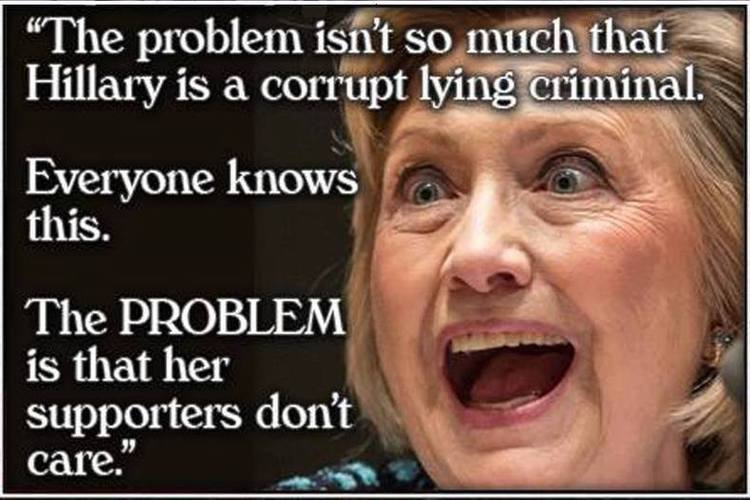
Regardless of if Hillary is innocent or crooked, her behavior and reaction to accusations is enough for people to question her trustworthiness and ability to run the country. I do not think it is possible for her to ever change that perception of her in the eyes of many people. The media, particularly social media, is very powerful and will fuel the vicious cycle of hate towards Hillary Clinton. There will always be people who feel angst towards her and those people often use media in the form of articles, Facebook posts, memes, etc. to voice their opinions. Then, people who feel similarly will share it and anyone who sees it will be influenced and affected by it in one way or another.

Here are some examples of the ridiculous Hillary memes being shared on the internet. Enjoy.